
Jeremiah Teams propose changes
to districts, conference structure
The South Carolina Conference Jeremiah Teams have proposed to the members of the Special Called Annual Conference concrete and practical steps to transform how the conference is structured, how it operates, and how it aligns with “Our 4 Priorities.”
Their recommendations, submitted to the Conference Secretary on Thursday, September 18, and shared with voting members of the Annual Conference, would go into effect July 1, 2026.
Bishop Leonard Fairley, who will preside over the October 18 called session, thanked the members of the Jeremiah Teams for their “faithful and diligent work within a challenging timetable,” and asked all South Carolina United Methodists to pray for the lay and clergy voting members of Annual Conference as they prepare to make “momentous decisions.”
“God has provided the people called United Methodist in South Carolina ample resources to further God’s kingdom on earth,” Bishop Fairley said. “Together, we will move forward; we will lean in to God’s promised hope; we will fix our eyes with determination on God’s promised future.”
Of the four Jeremiah Teams – Missional Priorities, The Black Church & Ethnic Ministries Strategy, District Alignment, and Conference Staff Alignment – the Annual Conference will vote on specific motions from two of the teams:
- “The District Alignment Jeremiah Team moves that the South Carolina Annual Conference begins a gradual process of downsizing its number of districts. Phase 1 would reduce the Annual Conference to 10 districts and 10 District Superintendents, to be implemented by July 1, 2026, with continuous planning for further reduction as indicated.”
- “The Conference Staff Alignment Jeremiah Team moves that the South Carolina Annual Conference restructures the Office of Congregational Development as follows: Combine the current responsibilities of this office with the continuing work of Connectional Ministries, creating the new Office of Congregational Excellence. The current full-time Extended Cabinet position ‘Director of Congregational Development’ will become a part-time clergy appointment with the title ‘Director of Innovation and Strategy,’ supervised by the Director of Congregational Excellence (formerly the Director of Connectional Ministries).
District Alignment
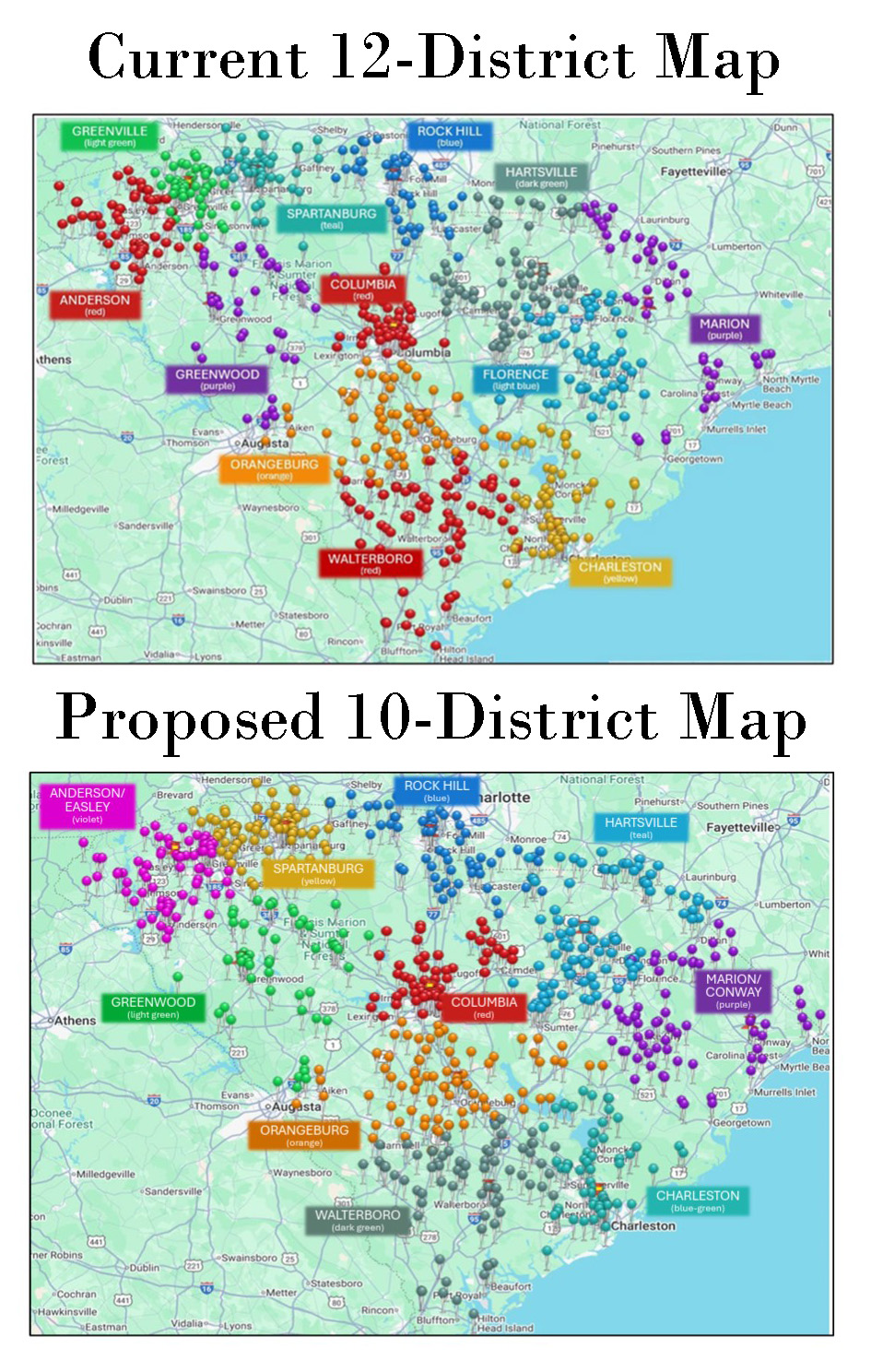
The proposed 10-District Option would merge the Greenville District into the Anderson and Spartanburg districts by:
- Realigning Greenville District churches to the Anderson and Spartanburg districts, based on GPS distances to the district offices.
- Realigning several churches in the eastern Spartanburg District to the Rock Hill District.
- Relocating the Anderson District Office to Easley, making the district office more centrally located within the newly aligned district.
The proposed 10-District Option would merge the Florence District into the Hartsville and Marion districts by:
- Realigning the Florence District churches west of I-95, as well as the churches within the city of Florence, to the Hartsville District.
- Realigning the Florence District churches east of I-95 to the Marion District.
- Realigning the Florence District churches south of U.S. 521 to the Orangeburg District.
- Realigning the Marion District churches west of I-95 to the Hartsville District.
- Realigning the Hartsville District churches in the Camden-Lugoff area to the Columbia District.
- Realigning several churches in the northwest Hartsville District to the Rock Hill District.
- Relocating the Marion District Office to Conway, making the new location more centrally located within the newly aligned district.
The 10-District Option – with 10 district superintendents and 10 district administrative assistants – would save an estimated $467,428 per year in operating costs over the annual cost of operating 12 districts with 12 district superintendents and 12 district administrative assistants.
The difference in estimated apportionment values between operating 10 districts instead of 12 districts would be $490,428.
Conference Staff Alignment
The creation of the Office of Congregational Excellence would:
- Continue the ongoing work of Connectional Ministries and take on the newly reshaped work of Congregational Development – leading the development of resources and strategies for ministry, faith formation, spiritual growth, outreach, and the overall health of congregations in the South Carolina Conference.
- Eliminate one full-time Extended Cabinet position, while ensuring all responsibilities are still met.
- Leave open indefinitely two full-time congregational specialist positions and one half-time congregational specialist position.
- Save an estimated $400,000 annually.
Under the proposed staff realignment, the newly created Director of Congregational Excellence would have responsibility for:
- The continuing work of Connectional Ministries, which would be overseen by the elected convener of the Conference Connectional Ministries Team, with support from the Director of Congregational Excellence, three congregational specialists, and other conference staff.
- The reshaped work of Innovation and Strategy, which would be overseen by a director of Innovation and Strategy, a part-time clergy appointment for someone also serving a local church. This person would be the conference staff liaison to the Conference Board of Congregational Development, along with the Director of Congregational Excellence.
“This is not a one-and-done proposition,” the Jeremiah Teams stated on their report to the Annual Conference. “What these teams are proposing, and will continue to champion, will take the persistent, intentional attention of all South Carolina United Methodists – from the local church level all the way through conference leadership.
“We all have a role to play in building, planting, sowing, reaching, and sharing the Gospel.”
Read the full report at ac2025.umcsc.org.
Read the full Jeremiah Teams
Report to Annual Conference
Read the full Jeremiah Teams Report to Annual Conference
Non-Action Reports
The two other Jeremiah Teams – Missional Priorities and The Black Church and Ethnic Ministries Strategy – also shared their work with the Annual Conference, but did not ask members to take any action at this time.
Missional Priorities
The driving motivation of the Missional Priorities Team is centered on the scriptural Great Commission and taken word-for-word from the mission of The United Methodist Church: “Making disciples of Jesus Christ for the transformation of the world.”
The team believes that mission requires action, represented by the first word in Matthew 28:19: “Go, therefore, and make disciples…”
“‘Go’ is action. ‘Go’ is intentional. ‘Go’ is imperative,” the team wrote. “‘Go’ is the critical first step in the act of sharing the teachings of Jesus. It is the first step in making disciples. It is the first step in evangelism.
“We believe that no ministry in the church is more vital than evangelism, especially when it is focused on key areas.”
The team identified those key areas as:
- Prioritizing Children, Youth & Young Adults
- Equipping Churches to Reach New People
- Fostering Intentional Inclusion & Diversity
- Increasing Clergy Effectiveness for Lasting Impact
- Improving & Expanding Communication
Moving forward the Missional Priorities Team is continuing to study how resources and staff align with these priorities in such areas as financial wellness, ongoing evaluation, and improving coordination with existing structures.
The Black Church & Ethnic Ministries Strategy
The Black Church and Ethnic Ministries Strategy Team was charged with creating and resourcing an effective conference strategy for strengthening the Black Church and other Ethnic Churches and Ministries, while staying attentive and looking for the new thing God is calling for in this area.
It has centered its work on three key questions:
- What have we learned?
- What are our next steps?
- How will we accomplish this?
Key findings from the team’s research include:
- More than 1/3 of churches in the South Carolina Conference are home to black congregations, and only one active Korean congregation.
- Wide swaths of the state are not being served by a black or ethnic United Methodist presence.
The team’s continuing work includes:
- Developing a plan to support leadership, resourcing and discipleship within thriving Black and Ethnic ministries across South Carolina.
- Evaluating current realities and missional possibilities and opportunities among all Black and Ethnic Churches and Ministries.
- Beginning to tell the story of Black and Ethnic churches through a 10-year narrative project.
- Creating intentional discipleship frameworks and processes to nurture and develop spiritually grounded, principled, and maturing Christian disciple leaders.
- Examining current charge and church configurations to determine their effectiveness and sustainability in their ability to connect with and grow world-transforming disciples of Jesus Christ.
- Fostering conversations within Black and Ethnic churches to promote the revitalization of existing churches.
- Identify the best practices of growing and thriving ethnic ministries and sharing them with all churches.
The team included one suggestion for the Bishop and Appointive Cabinet to consider: Creating an appointment partnership between Trinity United Methodist Church in Orangeburg and the Orangeburg Wesley Foundation, through which the Wesley Foundation director could serve as an associate pastor at Trinity.
